Monday, 20 June 2016

Technology 2015-2016

During this school year, in technology subject we've done many activities, many projects and many units.

In the first term we did a unit called "Technology and Society", in which we worked and learned about how technology has affected our society. We did many projects and we used lots of different TIC tools, like Glogster, Padlet, Google Drive, and many others. We also did many tasks, like the oral presentations about the different types of pollution, and the project about the water filter.

In the second term, we did the unit about Plastics. In this unit, we also did many projects and many activities. For example, we did an activity that consisted of going round our high school and searching plastics on the floor, and then classifying them. We also did a natural chewing gum, with no artificial products, and we also created a web page about plastics. We used many TIC tools, like Google Sites, Google Maps ad Toondoo.

And in the last term, we did two units, one about Eectricity and the other about Energies. In this term we worked mainly in the workshop, because we had to make a project with LEDs, LDRs, transistor and resistances, and it was not easy. We also did activities about the magnitudes of electricity, like power, voltage and resistance, and we also did an activity to learn how an electricity bill worked. In the unit about energies, we did a project that consisted of building a sun oven. We also did an activity with Scratch, in which we learned a lot about the different kinds of energy sources, the renewables and the non-renewables, and their advantage and disadvantages.
In my opinion, this subject has been one of the most interesting that I have done during this year. Not only because we've done lots of things, also because we did many practical projects, that we had to build them ourselves, and I think this part of the subject is the most useful for ourselves. Another thing I've liked is that we had to do many activities in group, so we socialized more and we learned how to work in a group, sharing different opinions and hearing and learning from the others. As it's said, "teamwork makes dream work". The thing I liked most was the project about electricity, the one with the LEDs and LDRs, transistors and resistances. It was the most difficult I've done this year, but it was very interesting to learn and make a project with these components. I think all these things will be very useful for the following years in school and for the rest of our lives. Because we've done many ecological projects and activities, and we've learned how to protect our planet. We've also done many things that can help us on a daily problem, like fixing a broken electrical circuit and things like that. I've also learned how to work with many new TIC tools, that can be useful for the following years for presenting projects or doing them. I really recommend this subject, because we do many practical projects and we learn lots of useful things. I've enjoyed it so much!


Energies and Scratch

The last tasks we did this term were some projects about energies, especially the renewable ones. We did a projects consisting of designing and making a sun oven and test it, and the other one was about designing a game with a TIC tool called Scratch.


I think during this term I've learned many things about energies, how do they work, how do they produce the electricity, the advantages and disadvantages of each one, and especially, the amount of pollution the produce.

The activity that helped me to learn all these things about the energies was the one with the Scratch. In this activity we searched a lot of information about the solar energy, the eolic energy, tidal energy, hydroelectric, geothermal, biomass, petrol energy, coal energy, natural gas and nuclear energy. We also looked up their advantages and disadvantages, and if they were renewable or non-renewable. We divided them in renewables and non-renewables, and then we explained how did they work, and their advantages and disadvantages. Solar energy, eolic energy, tidal energy, hydroelectric energy, biomass energy and geothermal energy are the renewable ones. They don't pollute the environment and they will never end, we will always have their energy. The non-renewable are: petrol energy, coal energy, natural gas energy and nuclear energy. They pollute the environment, and they are one of the main causes of the climate change, and we will run out of the someday. I think this project was very interesting not only because we learned a lot of things about the different types of energy, also because we learned how to use a new TIC tool and how to program a game. Pretty useful!

Here's the link to our project: https://scratch.mit.edu/projects/114188763/


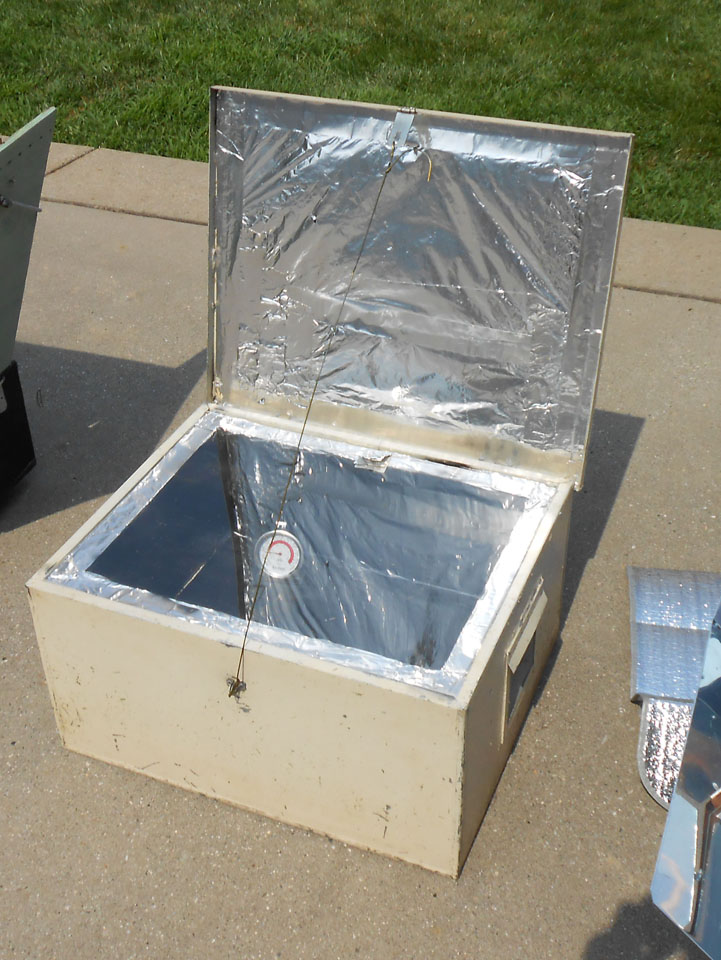
The other project we did was a sun oven. For this project we used the following materials: wood, newspaper, aluminium paper, glass, black paint and some tacks. We used the wood to build the skeleton of the project, and the tacks to attach them together. The newspaper worked as isolating material, so we put it between the big box and the small one, in order to trap the heat a much as possible. We used the black paint to paint the bottom of the project, to also gain more heat, and the glass to cover the upper part of the oven to trap the heat. Finally, the aluminium paper acted as reflecting material, in order to make the sunlight bounce inside the oven. Later, we tested it, and we tried to cook an egg, and it worked! We put the sun oven for six hours in the sun (a lot of time), but there were lots of cloud, so the sun was appearing and disappearing constantly. But in a normal day, you can cook an egg with 30 minutes. In my opinion, this task was very interesting because we had to make a real oven that had to be able to cook, and it was a project we hadn't done never before. It was a great task!


Sunday, 12 June 2016

What have I learnt about electricity?

The last unit we've studied has been electricity. It was a very interesting unit, where we've learned and done many things!  We also watched some videos in Edpuzzle in order to improve our knowledge on electricity.

We learned how to work with the Crocclip program. I think this program is very interesting ad useful, because you can draw and test any kind of electrical circuit, in series, parallel, with transistors, LDRs... any kind of circuit. With the Crocclip, I also learned the symbols of the components of the circuits, because you could choose either working with symbols or pictures. With this program we basically learnt how to work with bulbs, LEDs, LDR, resistances and transistors, because they were the components we needed for our project that we made later. It's a very useful tool!


We also did some exercises in order to practice the units and magnitudes of electricity. We learned how to calculate voltage (volts), power (watts), resistance (ohms) and energy (kWxH). We also studied Ohm's Law, which says that voltage is current per resistance. This was a very interesting activity because we practiced a lot with these magnitudes and units!


After practicing with units and magnitudes, and working with de Crocclip, we had to put the theory in practice. We had to build a project with some LEDs, resistances, transistors and LDRs. My partner and I decided to do an airport landing track. First, we made the skeleton of the project with some wood. We painted it so it seemed like a real landing track. Then, we built a prototype of the electrical circuit to make sure it worked. Our circuit consisted of: Two batteries of 4.5 volts in series, two resistances (one for the LEDs and the other for the transistor), one transistor, six LEDs in parallel and an LDR. When we were sure it worked, we introduced the final circuit in the wood plank. We had some problems, because some of the LEDs didn't work the first time, but in general it was very productive and interesting to build this project!  


Finally, we also watched, as usual, some videos in Edpuzzle in order to learn some theory and improve our knowledge. We watched a video about Ohm's Law, another about Electricity in general, and the last one about Watts. I think watching these videos in Edpuzzle is very useful because they're very catchy and visual, and keeps our attention. I love it!


Friday, 26 February 2016

What have I learned about plastics?

During this second term, we've been working with plastics. We've learned how are they made, the different types, what are they made of, how do they affect to our environment and the possible solutions to their impact.

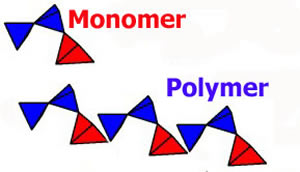
Plastics are made of monomers. Monomers are molecules that join chemically to other monomers to form a polymer. The process by which monomers join to form a polymer is called polymerization.

Polymerization is a process by which monomers join chemically to form a polymer. The monomers may be all of the same type, or they may contain different substances. At least 100 monomers are necessary to form a polymer that has certain properties, such as elasticity and the ability to form fibres.


There are three main groups of plastics: thermosets, thermoplastics and elastomers.

Thermosets are plastics that cannot be softened. If you try to heat them strongly, they break. They're hard, rigid and stronger than thermoplastics,. If you want to form a thermoset, you need to put the plastics through a curing stage. During this process, more links are formed between the original long chain molecule. This is called cross-linking. This process is irreversible, and that's why thermosets cannot be softened. 


Thermoplastics can soften very easily and can be reshaped as many times as you want. When the plastic is heated, the bonds between molecules are more weak, so they can reshape in a new position. Then, when the plastic is cooled again, the atomic bonds are strong again, so the plastics is hard and rigid.


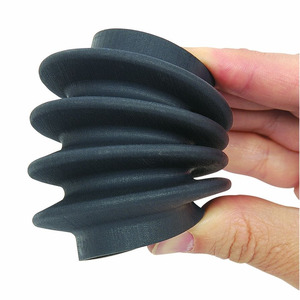
Elastomers plastics are similar to rubber. They're able to return to their original shape after being stretched. In normal conditions, the molecules making up an elastomer are irregularly coiled. With the application of force, the molecules straighten out in the direction in which they're pulled. Then, when no force is strightening them, the molecules return to their normal shape.


Plastics have many properties, but the main ones are these: Plastics are lightweight, they're resistant, they have a very good insulating capacity (electrical, thermal and acoustic), they're ease of handling and safety, they are very versatile, they are recyclable, they have a lot of uses, they have a cheap manufacturing, and they're impermeable. Because they have all these properties, they are practically in all the objects we use in out routines and lives.


However, plastics are not so good for our environment. Plastics pollute cities, ecosystems, forests and the sea. They contain many dangerous chemicals inside, and they are very difficult to decompose. For example, when an animal eats a piece of plastic, it doesn't digest it, and it stays inside the animal. Then, when a person kills the animal and eats it, the person will be polluted by the plastic. The sea is also very polluted. In the Pacific Ocean, there's a large concentration of plastic called "the plastic soup", and it's estimated that it covers 1.400.000 km2.


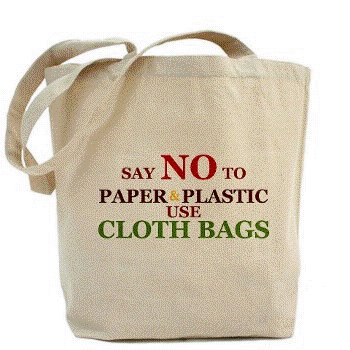
But fortunately, there are many solutions to solve this problem. We can do many things to help in the solution for this problem in our daily life. We can recycle all the plastic we can, throwing it in the correct bin, and applying the rule of the 3R (reduce, reuse and recycle). Then, recycled plastic is used for making other products, like for laying down roads in place of bitumen, for making bottles, benches, etc. We can also take a paper or cloth bag when we go shopping. In this way, we don't take any plastic bag, and we can rely less when shopping. We can also use the bins instead of throwing the rubbish on the floor, and we can avoid throwing plastic garbage in open spaces, water channels, rivers, the sea and the environment.


During this unit we've used some new TIC tools to do our presentations. Toondoo to do a comic, and Emaze to do a presentation about the making of our natural chewing gum.

The comic was created to warn people not to produce plastic rubbish. For this, we used Toondoo. It's an unusual tool where you can create as many comics as you want and the publish them. In the Toondoo creator there are lots of templates, objects, characters, many speech bubbles and onomatopoeias that you can use. The only problem we found is that you cannot create more than five vignettes in a comic, so we think it's a little short for a comic. But in general, it's a very creative TIC tool! Here's our comic: 


To do the presentation about the making of our natural gum we used Emaze. It was the first time we used it, and we wanted to try if it was good or not. And it's amazing! You can create as many presentations as you want and you can include images, text, pre-designed images, links and more things. There are many templates designed previously by the program that you can use for your presentation, or you can start from a blank template. But the most exciting thing is the dipositive transition. They're astonishing! They are in 3D. For example, we saw a template that was a gallery, and each wall was a dipositive. When you passed from a dipositive to another, it was like if you were walking through the gallery. It's very well-made. We think it's a cool TIC tool!


Sunday, 31 January 2016

What are phtalates?

Phtalates are a group of chemicals derived from phtalic acid, and they are used and mixed with plastics to increase their properties, like the flexibility, transparency, durability and longevity. They are divided in two different groups, with different applications, toxicological properties and classification, based on the number of atoms in their alcohol chain. They are mainly used to soften polyvynil chloride (PVC).


Phtalates are used in cosmetics and personal care products, such as perfume, hair spray, soap, shampoo, nail polish and skin moisturizers. They are also used in consumer products such as baby's toys, shower curtains, wallpaper, food packaging and plastic wrap. We can also find them in wood finishes, detergents, adhesives, plastic pumping pipes, lubricants, medical tubing, solvents, insecticides, medical devices, building materials and vinyl flooring. 


           Food packaging                                                                                    Cosmetics


Phtalates are dangerous not only for the environment, they are also dangerous for health. They destroy natural ecosystems, they pollute the natural resources and they reduce the area of available land space on Earth. Phtalates are also dangerous for our organism. They affect reproductive organs and hormones, especially in males. Some phtalates have been linked to breast and other cancers, allergies, obesity, thyroid, and other hormonal infections. However, the health effects of phtalates are not yet fully known, but are being studied by several government agencies, including the National Institute of Environmental Health Sciences.   

In this video (https://www.youtube.com/watch?v=ay-y3tSYGYw) two young scientists are trying to decompose phtalates using bacteria. Their idea is that bacteria have evolved and they are able to eat phtalates, and decompose them. In my opinion, I think their work is another example that not always accidents are bad for us. Their discovery of bacteria that can decompose phtalates is very interesting, not only because we can reduce the amount of this toxic substances, but also because they have shown that nature can evolve and adapt to nearly every change that it suffers. Maybe in a few years, we will be able to clean our seas and rivers, and our planet would be cleaner and less polluted.

Talking about accidents. An accident is something that happens without being planned previously, and they usually tend to be harmful and destroying. But not always accidents have been bad for us. For example, if the biologist Alexander Fleming accident with mould hadn't happened, he wouldn't have discovered the penicillin. And now, fortunately, penicillin has helped to solve many bacterial infections. In the video I've talked about, the two girls have many accident during their investigation, and thanks to these accidents, they have discovered the bacteria that can decompose phtalates. In conclusion, accidents are not always bad for us!                                                                                
                                                                               Alexander Fleming                       


Penicillin
     

Thursday, 24 December 2015

Hour of Code

The las assignment we have done in Technology subject has been Coding. It has been an extra activity before Christmas and also we've done this activity because two weeks ago was the Hour of Code.

The hour of code is a global movement that has arrived to millions of students in more than 180 countries in the world. Any person, in any place in the world, can organize a Hour of code.

Programming is definitely important. Lots of universities; thousands of professors; students and practitioners teaching, learning and practicing the coding are enough people to verify that coding is really important.

The main reasons for this are: 


  • To interact with machines and computers
  • To harness the power of computing in all human endeavour
  • To automate tasks
  • To create intelligent machines, robots, etc.

In my opinion, coding is now ad days really important. First, because without this technique, we wouldn't be able to  "communicate" with machines, robots and other electronic devices. Secondly, because now an important part of the tasks in factories and in jobs that require precision, are done by machines. Without coding, we wouldn't be able to programme the machines to do these tasks automatically. And finally, because we wouldn't be able to make new machines that could be more efficient, cheaper and more precise.

I made my Hour of code. It was an amazing experience because I had never programmed a machine to do things, and I did it for the first time. For my surprise, it was very easy and simple, and the robot did exactly what it was asked for. There were different levels, and each level was more difficult. The las level asked you to do your own game. It was very interesting. I think it was important for me because it was a pretty good introduction to the world of coding and programming.


 Here there's my link to the game I've created: https://studio.code.org/c/159088116


Thursday, 10 December 2015

Water filter projects

During these last weeks, in Technology subject we've been building some water filters in order to try to solve one of the main ecological problem now addays: the water scarcity.
I've learned many things from my project and from my classmates' presentations.
97% of the total water in our planet is in the sea, so it's salty. A 2% of the water is located in glaciers, so we can't drink it. And only a 1% remaining is fresh water, and a lot of this 1% is polluted,. There are many countries that have large quantities of polluted water, like Zimbawe, Republic of Congo, Senegal, Qatar, Singapour, Cyprus... Polluted water can also cause illesses like Typhod fever and Polyomielitis.


To build this water filter we've used very simple materials. As filters we have used stones, cotton, gauzes and sand, in order to not allow dirt pass through. We've used a plastic bottle of 1,5 l as a container, and the stopper of the bottle as a funnel to carry fresh water to the container below.


Stones Sand Bottle


During the process we had some problems:

-We needed to take out all the sand because it went down the bottle and mixed with stones. We put a gauze between them in order to separate them and solve this problem.


While making this project I've learned many thing and I think I've improved my knowledge about water scarcity.